








Recap: DHC Life Sciences Day 2025: A successful debut in Saarbrücken
On November 6, 2025, DHC Dr. Herterich & Consultants GmbH opened its doors in Saarbrücken for the first DHC Life Sciences Day under the motto
“Compliance by Design – SAP Innovation Meets Regulation.”

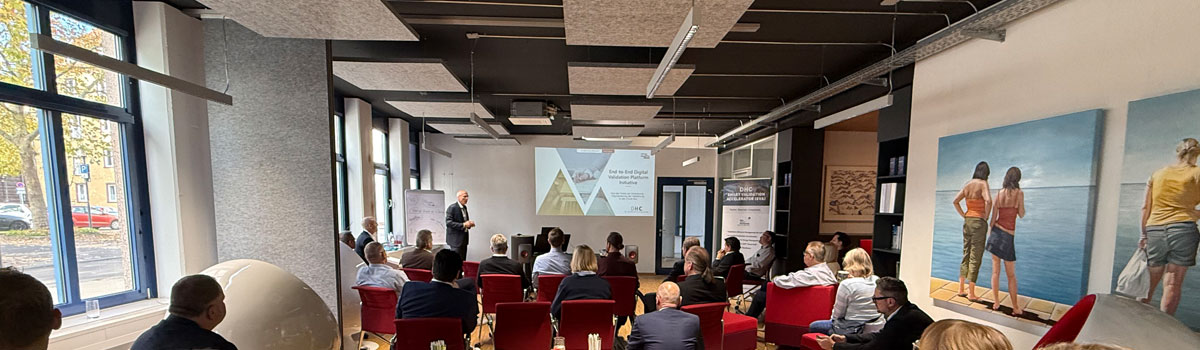
DHC Life Sciences Day 2025
The event brought together leading representatives from pharmaceutical and MedTech companies to discuss current developments at the intersection of SAP technology, GxP compliance, and digitalization.
With contributions from experts at companies such as SAP, Ursapharm, Greiner, Sartorius, Carl Zeiss and other industry leaders, the day offered a rich program full of practical insights and future perspectives.
Opening Remarks and WelcomeOpening Remarks and Welcome
The day was opened by Dr. Rudi Herterich, Managing Director of DHC, and Karsten Schulz, Director Sales, Marketing & Business Development. In their welcome, they emphasized that “Compliance by Design” is not just about technology but about the intelligent connection of regulation, efficiency, and innovation.
From this emerged the following theses that formed the content framework of the day:
- “Reduce to the Max” – as little as possible, as much as necessary.
- Classical validation is a thing of the past.
- Automation of validation processes is mandatory.
- Use validation as a service across company boundaries.
These guiding principles ran like a common thread throughout the day, from overarching SAP topics to practical project insights.
As a visible symbol of this, Schulz brought a relay baton with a red thread right at the beginning, which was symbolically passed from speaker to speaker throughout the day as a connecting element.
Keynote: Dr. Wolfgang Schumacher
The first expert presentation was given by Dr. Wolfgang Schumacher, auditor and former employee at F. Hoffmann-La Roche.
In his keynote “Life Sciences in Transition: Regulatory Trends and Opportunities Through Innovation,” he examined the increasing complexity of regulatory requirements in the age of cloud and SaaS.
Using numerous practical examples from international inspections, he showed how significantly the expectations of authorities have changed.
Inspection reports are now exchanged between authorities, a trend that obliges companies to maintain consistent documentation, clear accountability, and well-founded quality oversight.
Particular focus was on the Annex 11 draft (July 2025) and the GAMP 5 Second Edition, which set new standards for multi-factor authentication, periodic reviews, and penetration tests.
Structured supplier management and regular supplier audits are essential, especially for cloud solutions like SAP S/4HANA.
Schumacher made clear that validation today is a continuous, technology-supported process.
Automated tests, electronic documentation, and risk-based approaches according to CSA are the key to combining compliance and efficiency.
His conclusion: Digitalization is fundamentally changing validation; it requires expert knowledge, integrated tools, and close collaboration between manufacturers, providers, and service partners.
SAP Business Suite & SAP Cloud ALM
Susan Finger and Lisa Sanders from SAP then continued the central theme of the day.
Finger, Architecture Advisor Life Sciences and Customer Advisory Process & Life Sciences at SAP, presented the newly designed SAP Business Suite for Life Sciences, which is built as a modular, cloud-based platform on the SAP Business Technology Platform (BTP).
She demonstrated how industry-specific extensions, such as for cell and gene therapy, clinical trials or batch releases, help optimize specific processes in life sciences with SAP and ensure transparency and traceability across the entire value chain.
A central element is the SAP Business Data Cloud, which makes operational data available in a context-aware manner and thus enables AI-powered analytics.
With the RISE methodology and SAP Cloud ALM, companies can structure their cloud transformation in a standardized and compliant way, in close collaboration with partners like DHC, who enable validation directly within the system environment.
Lisa Sanders, Product Expert Application Lifecycle Management Cloud, built on this.
She explained how implementation, test and change management are digitally connected in Cloud ALM, enabling SAP systems to be efficiently transformed from SAP ECC to the SAP Business Suite and managed effectively.
Regular releases, ISO-certified development processes and features such as risk management, document approvals and segregation of duties make the tool a central building block for Compliance by Design.
Sanders highlighted the close cooperation with DHC, whose Smart Validation Accelerator can be integrated directly into Cloud ALM via standardized APIs, as a joint step toward a digitally validated, future-proof system landscape whose compliance status is efficiently maintained after updates.
Ursapharm and the Life Science Alliance: Collaboration for a GxP-Compliant S/4HANA Transformation
How companies can successfully manage the switch to S/4HANA under GxP conditions was demonstrated by Dr. Eric Schank, Head of SAP IT at URSAPHARM Arzneimittel GmbH, and Maximilian Gött, Sales Manager at the All for One Group.
Together with the All for One Group and KEK, DHC is part of the Life Science Alliance, a partnership that accompanies customers from the life science industry in implementation, process consulting, and validation from a single source.
URSAPHARM, a family-owned manufacturer from Saarbrücken with approximately 1,200 employees and worldwide exports, is currently preparing the migration of its long-used ECC system to S/4HANA Private Cloud. In a joint discovery phase with the Life Science Alliance, the existing system landscape was analyzed, GxP requirements were integrated, and a realistic roadmap for the migration project was developed.
Instead of a complete restart, URSAPHARM opted for a Bluefield approach, i.e., a gradual and validation-compliant evolution of existing processes.
Dr. Schank emphasized how important it is to implement optimizations in a targeted and measured way, to involve employees early on, and to understand validation as a continuous part of the project. The close collaboration between IT, business departments, and validation partners, coordinated through the Alliance, proved to be a central success factor.
Digital validation with the DHC Smart Validation Accelerator and SAP Cloud ALM
The subsequent topic block focused on the future of computer system validation.
Matthias Bothe, Managing Director of DHC, demonstrated in his session on the “End-to-End Digital Validation Platform Initiative” how validation processes can be mapped end-to-end digitally and integrated with the SAP tools Cloud ALM, Signavio and the DHC Smart Validation Accelerator (SVA).
The goal is to replace traditional document-based workflows and to manage validation directly within the system in the future. It should be fully integrated, traceable and audit-ready.
Bothe emphasized that the requirements for GxP compliance have changed significantly due to frequent cloud releases and the increased use of AI-powered applications. To meet this dynamic, automated traceability, database-driven documentation instead of static Word files and close interaction between project management, test management and change control are needed.
The DHC Smart Validation Accelerator, a solution developed by DHC as part of the SAP End-2-End Digital Validation Platform Initiative, extends SAP Cloud ALM with precisely these functions, including electronic signatures, risk assessments, automated traceability and risk matrices as well as a GxP-compliant change process with a change impact analysis. A live demo of the system rounded off the presentation.
Dominik Hubertus, Director Innovation & Technology at DHC, and Sandra Haslehner, Senior Expert IT CSV at the Greiner Group, demonstrated how this works in practice, with insights into the ongoing SAP S/4HANA implementation project.
The Austrian company uses SAP Cloud ALM as its central project and lifecycle management tool and maintains all validation-relevant data there, from user requirements through functional specifications to test cases.
The DHC Smart Validation Accelerator (SVA) automatically picks up this information, consolidates it and enables approvals via electronic signature.
Haslehner emphasized that a global project of this scale, with around 190 team members and over 200 processes, can only be managed digitally.
Instead of maintaining countless Word and Excel files, all content is centrally managed in Cloud ALM, ensuring it remains up to date, traceable and audit-proof at all times. Validation in the DHC SVA thus becomes an integral part of the project and system lifecycle, an important step toward Compliance by Design.
Automated Testing as a Key to Success – Sartorius
Another highlight of the day was the contribution by Dr. Peter Skwara, Information Technology Quality Assurance Professional at Sartorius Corporate Administration GmbH, who provided insights into the company’s worldwide S/4HANA conversion. The project was implemented on an all-at-once basis, meaning all three regions and 21 production sites went live simultaneously. Within just twelve months, the transition to a validated S/4HANA system with global usage was achieved.
To ensure quality and stability, Sartorius consistently relied on test automation. With the support of a partner, more than 9,000 test runs were conducted and over 94% of regression tests were automated. The sandbox approach proved decisive in testing processes early, detecting errors, and building confidence in the new system.
The result: a virtually error-free go-live with 99.4% passed tests and a hypercare phase of only two weeks. Test automation proved to be the key at Sartorius for reconciling quality assurance, speed, and compliance.
Global SAP S/4HANA Validation in a Regulated Environment – Carl Zeiss
To close, Martin Geiger, Validation Manager in the global SAP project “FIT4” at Carl Zeiss, provided insight into the company’s validation strategy. The goal of the multi-year project is to build a globally unified, validated S/4 template that meets regulatory requirements across all business areas.
The program encompasses over 850 end-to-end processes, more than 100 locations, and approximately 14,000 SAP users. The risk-based approach follows GAMP 5 and combines central standardization with local responsibility. Validation documentation is performed in the SAP Solution Manager with electronic signatures, complemented by SAP Signavio and Jira for process and requirements management.
Zeiss places particular emphasis on quality gates, clear roles, and trained project teams. In the long term, the company aims for a more object-based, partially automated validation as the foundation for a global, future-proof SAP landscape while maintaining the highest compliance standards.
Conclusion & Outlook
After a day full of exciting insights, lively discussions, and practical impulses, the first DHC Life Sciences Day concluded in a relaxed atmosphere.
During the shared lunch, at the candy bar, and in the coffee breaks, participants took the opportunity to exchange ideas and make new connections.
In the end, the common thread even became edible:
For every completed feedback form, there were red sweets in the form of long “red threads,” a sweet conclusion to a day full of exchange, ideas, and good conversations.
Participant feedback was consistently positive: Particularly praised were the exciting insights into SAP Cloud ALM and the DHC Smart Validation Accelerator, the inspiring customer presentations from companies such as URSAPHARM, Sartorius, and Greiner, as well as the open, relaxed atmosphere.
Many wished for even more exchange, live demos, and practical examples next time, and some even for a two-day event.
With this feedback in hand, DHC Dr. Herterich & Consultants GmbH is already looking forward to the DHC Life Sciences Day 2026, which will once again take place in Saarbrücken.
Next year, too, the industry meeting point will address current topics around SAP, GxP, and digital validation, with new insights, exciting project examples, and of course plenty of room for networking.
→ Info about DHC Life Sciences Day 2026
